
Special Academy
Fixed Wing Training Syllabus
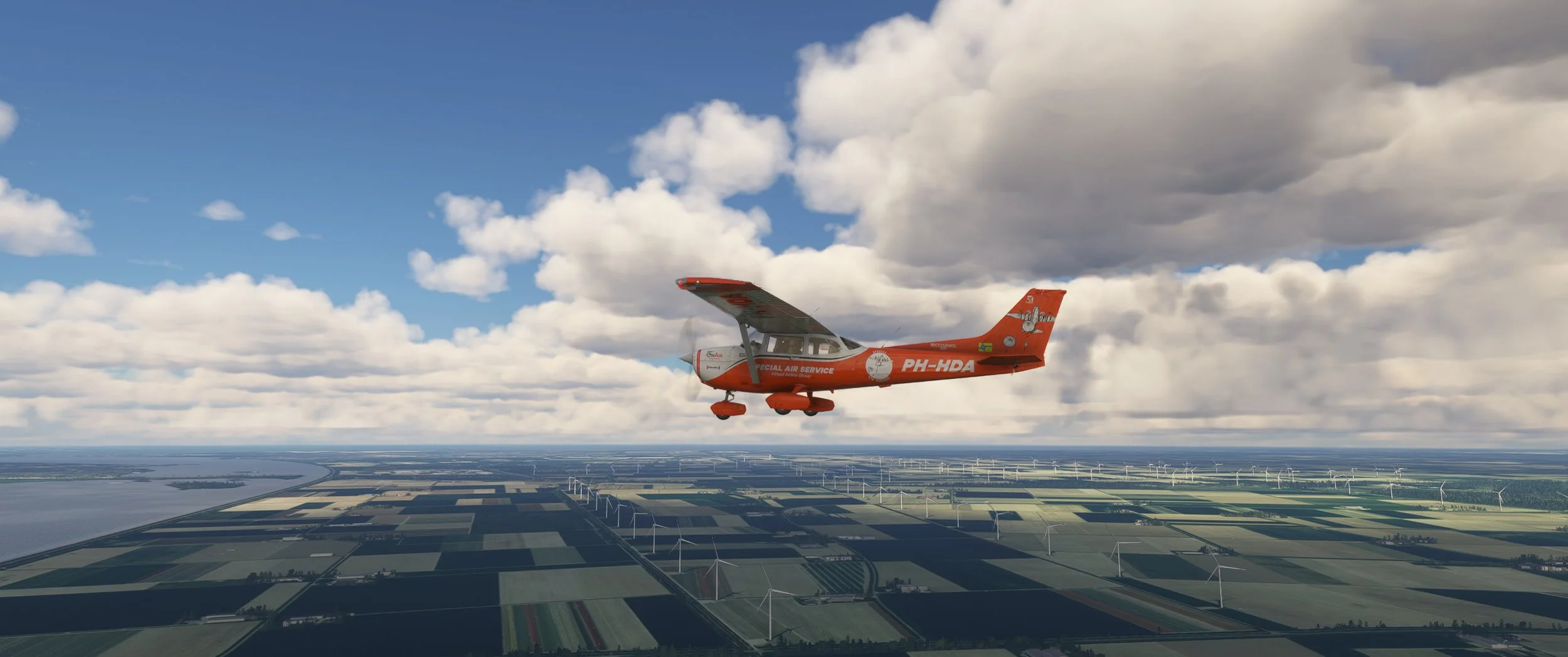
Welcome to the Fixed Wing Training Syllabus for the Special Air Service Virtual Airline Group. Because you are piloting the single-engine piston Cessna 172 Skyhawk, your training focuses entirely on stable cross-country navigation, strict airspace boundary management, and mastering visual and instrument airport integration.
Objective
The Fixed Wing Training Syllabus is a specialized flight program designed to transition incoming pilots into the operational structures of the Special Air Service Virtual Airline Group. The curriculum isolates the distinct airmanship, energy management, and airspace tracking skills required to pilot light fixed-wing aircraft within the European airspace network.
Standard Flight Profile
En-Route Cruise Altitude: Maintain appropriate VFR altitudes at all time, at low level altitudes at least 1,000 feet AGL. In most of the western part of the Netherlands you’re restricted to stay below the Class A airspace (often starting at 1,500 feet MSL). Above the transition level, pilots should maintain standard VFR cruising altitudes (odd thousands + 500 feet for eastbound tracks, even thousands + 500 feet for westbound tracks)
Airfield Pattern Altitudes: All airfields in the Netherlands have dedicated circuit patterns as described in Part 3 Aerodromes AD 2 in the eAIP of Lucht Verkeersleiding Nederland. Pilots should strictly adhere to the procedures and regulations in these documents.
Fleet Authorization
Trainees are restricted to the Cessna 172 Skyhawk. Operations are confined to a 150 NM geographic radius from EHLE Lelystad Airport. Operations outside Dutch airspace are strictly prohibited during this training phase.
Real-World Operational Restrictions (LVNL Compliance)
Because the Special Air Service Virtual Airline Group enforces a high-fidelity environment synchronized with online ATC networks (VATSIM/IVAO), all trainees must strictly adhere to the permanent real-world airspace restrictions instituted by Luchtverkeersleiding Nederland (LVNL) following the 2019 ATC transition:
Corridor Closures: The BRAVO Arrival and the MIKE Departure are strictly PROHIBITED and unavailable for use.
Mandatory Routing: All VFR flights must depart EHLE Lelystad Airport via the BRAVO Departure and arrive via the MIKE Arrival routes as explicitly dictated by the current eAIP.
Graduation Requirements
To shed the Trainee restrictions and unlock the advanced complex fixed-wing or high-performance twin-engine fleet, a pilot’s OnAir profile must verify the following four metrics:
Syllabus Completion: Successful execution of the 5 mandatory round-trip phases (10 legs total).
Flight Endurance: A minimum of 5.0 flight hours logged via the OnAir tracking client.
Experience Points: Validation of a minimum 500 XP accumulated on the pilot profile.
The Precision Landing Streak: A consecutive sequence of 3 landings rated "Good" or "Very Smooth" by the OnAir safety engine. Any hard touchdown or excessive sideloading will instantly reset the landing streak counter to zero.
Fleet Management (The 24-Hour Rule)
Because the company operates a shared, persistent fleet within OnAir, aircraft logistics are strictly monitored. Trainees are encouraged to fly both the outbound and inbound legs of a training phase back-to-back. If a flight must be split, the return leg to EHLE Lelystad Airport must be completed within 24 hours of the initial outbound touchdown. Abandoning a Cessna 172 at an outstation beyond this window will result in an immediate phase reset.
Cessna 172 Fuel Matrix
Type of Fuel: Avgas 100LL (~0.72 kg per liter / ~2.72 kg per US Gallon)
Standard Fuel Burn: 38 Liters/hr / 27 KG/hr / 10.0 USG/hr (approx. 0.45 kg per minute)
Standard Usable Tank Capacity: 204 Liters / 54.0 USG
Mandatory VFR Safety Reserve: 45 Minutes minimum (28,5 Liters / 7.5 USG)
Training Syllabus
Phase 1: The First Solo Cross-Country (EHLE ↔ EHTE)
Route: EHLE Lelystad Airport → EHTE Teuge → EHLE Lelystad Airport
Primary Purpose: Visual Navigation & Uncontrolled Airfield Familiarization
Detailed Description: This initial phase serves as the foundational handling and navigation benchmark for the Cessna 172. Trainees depart EHLE Lelystad Airport via the BRAVO Departure, tracking away from home base toward the southeast. The flight is a short, confidence-building hop designed to establish stable cruise trim and precise airspeed control. At Teuge, the pilot must locate the airfield without ATC vectors, self-announce positions on the local traffic frequency (Teuge Radio: 121.005), and execute a standard visual pattern entry. The return leg will take pilots via the river IJssel back north, around the Lelystad TMA’s where they’ll fly the MIKE Arrival into EHLE Lelystad Airport.
The "Why": Because trainees depart from the busy, controlled Class D tower environment of EHLE Lelystad Airport, their first cross-country must focus on the critical transition to an uncontrolled airfield. EHTE Teuge features a wide, highly visible paved asphalt runway (08/26) without the presence of radar or tower controllers. This forces the trainee to step away from the safety net of ATC instructions. They must master the art of self-announcing their positions, scanning the sky for local traffic, and executing an unhurried, self-separated visual landing pattern based entirely on pilot-to-pilot communication.
Flight 1:
Route:EHLE BRAVO DCT Harderwijk DCT Apeldoorn DCT SIERRA DCT EHTE
Distance: 39 NM | Est. Airborne Time: 19 MIN
Trip Fuel: 9 KG / 3 USG | Minimum Dispatch Fuel: 34 KG / 13 USG
Flight 2:
Route: EHTE DCT Wijhe DCT Zwolle DCT IJsseloog DCT MIKE DCT EHLE
Distance: 49 NM | Est. Airborne Time: 29 MIN
Trip Fuel: 14 KG / 5 USG | Minimum Dispatch Fuel: 57 KG / 21 USG
Phase 2: The Controlled Airspace Introduction (EHLE ↔ EHGG)
Route: EHLE Lelystad Airport → EHGG Groningen Airport Eelde → EHLE Lelystad Airport
Primary Purpose: ATC Communications & CTR Procedures
Detailed Description: Phase 2 introduces the trainee to large-scale international airport infrastructure and mandatory VFR corridor routing. Tracking northeast, the flight length increases significantly, demanding active fuel monitoring and cruise efficiency. As the aircraft approaches the expansive Groningen Control Zone (CTR), the trainee must strictly adhere to published VFR arrival procedures, establishing positive radio contact with Air Traffic Control before entering the CTR via the ROMEO Arrival. On departure for the return leg, pilots will fly the UNIFORM Departure route back to home base.
The "Why": Operating a fixed-wing aircraft in a professional VA requires absolute precision when navigating heavily regulated terminal areas. Because trainees are already accustomed to Lelystad's busy GA environment, this phase focuses on mastering mandatory VFR arrival and departure routes. Entering a major international CTR via the ROMEOArrival and exiting via the UNIFORMDeparture requires meticulous pre-flight chart study and flawless timing. It builds the specialized division of attention needed to fly precise headings and altitudes along a strictly mandated visual corridor while simultaneously coordinating with tower controllers through a large-scale commercial terminal environment.
Flight 3:
Route: EHLE DCT BRAVO DCT Elburg DCT Zwolle DCT Meppel DCT Dwingeloo DCT ROMEO DCT EHGG
Distance: 73 NM | Est. Airborne Time: 39 MIN
Trip Fuel: 17 KG / 6 USG | Minimum Dispatch Fuel: 42 KG / 15 USG
Flight 4:
Route: EHGG DCT UNIFORM DCT Giethoorn DCT MIKE DCT EHLE
Distance: 68 NM | Est. Airborne Time: 41 MIN
Trip Fuel: 20 KG / 7 USG | Minimum Dispatch Fuel: 45 KG / 17 USG
Phase 3: The Commercial IFR Environment (EHLE ↔ EHRD)
Route: EHLE Lelystad Airport → EHRD Rotterdam The Hague Airport → EHLE Lelystad Airport
Primary Purpose: High-Density Flight Planning & Instrument Procedures
Detailed Description: This phase serves as the mid-term check, introducing the trainee to formal Instrument Flight Rules (IFR) procedural discipline. Navigating southwest, trainees will utilize SimBrief to file an official IFR flight plan. Rather than navigating visually, the pilot must strictly adhere to the published Standard Instrument Departures (SIDs) out of EHLE Lelystad Airport and Standard Terminal Arrival Routes (STARs) into EHRD Rotterdam Airport, which are dynamically dictated by wind direction. The trainee must manage precise altitude constraints embedded within these procedures, ultimately sequencing directly with commercial narrowbody airliner traffic on arrival at Rotterdam.
The "Why": EHRD Rotterdam Airport requires high structural and procedural discipline. This phase transitions the pilot into the world of IFR flight, testing their ability to interpret and execute complex electronic routing before the engine ever starts. By forcing the trainee to strictly adhere to published SIDs and STARs, the flight trains them to maintain absolute compliance with chart-dictated altitude and speed constraints. It builds the advanced cockpit management skills required to safely manage automated or structured navigation while seamlessly sequencing into a continuous stream of commercial jet traffic.
Flight 5 West DEP/ARR:
Route: EHLE/23 INKE2M INKET INKE2R EHRD/DOFMU.I24-Z
Distance: 150 NM | Est. Airborne Time: 85 MIN
Trip Fuel: 36 KG / 13 USG | Minimum Dispatch Fuel: 71 KG / 26 USG
Flight 5 East DEP/ARR:
Route: EHLE/05 INKE1L INKET INKE2R EHRD/DOFMU.I06
Distance: 138 NM | Est. Airborne Time: 78 MIN
Trip Fuel: 31 KG / 11 USG | Minimum Dispatch Fuel: 65 KG / 24 USG
Flight 6 West DEP/ARR:
Route: EHRD/24 NEPT2B NEPTU T604 BADEX DCT EHLE/BADEX.R23
Distance: 148 NM | Est. Airborne Time: 81 MIN
Trip Fuel: 36 KG / 13 USG | Minimum Dispatch Fuel: 88 KG / 32 USG
Flight 6 East DEP/ARR:
Route: EHRD/06 NEPT2A NEPTU T604 BADEX DCT EHLE/BADEX.I05
Distance: 131 NM | Est. Airborne Time: 74 MIN
Trip Fuel: 33 KG / 12 USG | Minimum Dispatch Fuel: 81 KG / 30 USG
Phase 4: The Coastal Weather & Grass-Strip Test (EHLE ↔ EHTX)
Route: EHLE Lelystad Airport → EHTX Texel International Airport → EHLE Lelystad Airport
Primary Purpose: Soft-Field Mechanics & Crosswind Management
Detailed Description: Trainees head north out of EHLE Lelystad Airport, crossing the open polder lines and tracking over the water boundary to the island of Texel. This environment introduces highly dynamic coastal winds and unpredictable weather of the North Sea. EHTX Texel International Airport is famously the largest pure grass airfield in the region. Upon arrival, the trainee must abandon standard asphalt landing profiles, establish a precise soft-field approach matrix, and handle aggressive, unobstructed maritime crosswinds on short final.
The "Why": Paved runways mask minor errors in aerodynamic technique; grass runways do not. This phase forces the trainee to master the Soft-Field Landing andTakeoff techniques. They must manage elevator authority to keep the nosewheel light on the turf, account for severely degraded braking action if the grass is damp, and maintain a rigorous crosswind crab angle right down to the numbers to prevent side-loading the gear.
Flight 7:
Route: EHLE DCT BRAVO DCT Elburg DCT IJsseloog DCT Enkhuizen DCT Medenblik DCT Wieringen DCT ALPHA DCT EHTX
Distance: 79 NM | Est. Airborne Time: 40 MIN
Trip Fuel: 20 KG / 7 USG | Minimum Dispatch Fuel: 45 KG / 17 USG
Flight 8:
Route: EHTX DCT Wieringen DCT Medenblik DCT Enkhuizen DCT MIKE DCT EHLE
Distance: 58 NM | Est. Airborne Time: 34 MIN
Trip Fuel: 16 KG / 6 USG | Minimum Dispatch Fuel: 41 KG / 15 USG
Phase 5: The Endurance Navigational Challenge (EHLE ↔ EHBK)
Route: EHLE Lelystad Airport → EHBK Maastricht Aachen Airport → EHLE Lelystad Airport
Primary Purpose: High-Endurance Cross Country & Topographical Transition
Detailed Description: The final graduation milestone. This is the longest cross-country mission in the training portfolio, pushing the Cessna 172 near its maximum training radius to the southern tip of the Netherlands. Trainees will manage a heavy maximum-takeoff-weight (MTOW) fuel load out of Lelystad. The flight track crosses several active military restricted areas and regional CTRs, forcing continuous navigation adjustments. As they approach EHBK Maastricht Aachen Airport, the flat Dutch polders give way to rolling, undulating terrain, introducing shifting wind gradients and variable approach sightlines.
The "Why": This endurance leg tests overall flight discipline, fuel depletion monitoring, and sustained cockpit management. Pilots cannot simply engage autopilot and walk away; they must constantly cross-reference ground tracks, manage engine mixtures for high-altitude cruise optimization, and adapt to the topographic wind shear generated by the hills around Maastricht. Successfully logging this phase completes the 5-hour training matrix.
Flight 9:
Route: EHLE DCT BRAVO DCT Harderwijk DCT Ede DCT Nijmegen DCT Ooijen DCT Venlo DCT BRAVO DCT EHBK
Distance: 109 NM | Est. Airborne Time: 60 MIN
Trip Fuel: 26 KG / 10 USG | Minimum Dispatch Fuel: 51 KG / 19 USG
Flight 10:
Route: EHBK DCT BRAVO DCT Venlo DCT Ooijen DCT Nijmegen DCT Dieren DCT Zwolle DCT IJsseloog DCT MIKE DCT EHLE
Distance: 140 NM | Est. Airborne Time: 75 MIN
Trip Fuel: 32 KG / 12 USG | Minimum Dispatch Fuel: 56 KG / 21 USG
Operational Note for Pilots: All SimBrief flight plans are made in advance to create company routes for the Fixed Wing Training Syllabus. Pilots MUST change the appropriate weights to the Freight, Payload or Zero Fuel Weight fields in order to calculate proper fuel calculations and take-off and landing calculations!